Best Window Treatments for Basement Windows: Small, Odd-Sized, and High-Humidity Solutions
Best Window Treatments for Basement Windows: Small, Odd-Sized, and High-Humidity Solutions
Basement windows present a unique set of challenges that standard window treatments are not designed to handle. They are often small, oddly shaped, positioned at or below ground level, and exposed to higher humidity than the rest of your home. On top of that, they need to balance privacy (since passersby look directly in), light maximization (since natural light is limited), and in many cases, compliance with egress safety codes.
This guide addresses every basement window challenge with practical solutions, from moisture-resistant materials to custom sizing for non-standard openings.
Why Basement Windows Need Special Treatment
The Humidity Factor
Basements are inherently more humid than above-grade living spaces. Concrete foundation walls absorb ground moisture, condensation forms on cold window glass, and limited ventilation keeps moisture trapped.
What humidity does to standard window treatments:
- Real wood blinds warp, swell, and eventually crack
- Fabric shades develop mildew and musty odors
- Metal components rust and corrode
- Adhesive-mounted options lose their grip
- Cord mechanisms stiffen and jam
Typical basement humidity levels:
- Unfinished basement: 50-70% relative humidity
- Finished basement with dehumidifier: 40-55% relative humidity
- Above-grade rooms for comparison: 30-50% relative humidity
Any window treatment you install in a basement must be rated for sustained exposure to humidity above 50%.
The Privacy Problem
Basement windows sit at ground level or slightly above, putting them at eye height for anyone walking past. Unlike second-floor windows where privacy is naturally provided by elevation, basement windows require deliberate privacy solutions.
Privacy challenges specific to basements:
- Street-level passersby can look directly in
- Window wells create a natural viewing angle into the room
- Nighttime interior lighting makes basements visible from outside
- Standard blinds that work for elevated windows may not provide adequate coverage at ground level
The Light Dilemma
Basements receive less natural light than any other room in the house. Window wells, small window openings, and north-facing orientations further limit light entry. The window treatment you choose needs to provide privacy without eliminating the limited daylight that does reach your basement.
Size and Shape Challenges
Basement windows come in sizes and shapes that are often outside standard window treatment dimensions:
- Hopper windows: Hinged at the bottom, swing inward from the top
- Awning windows: Hinged at the top, swing outward from the bottom
- Sliding basement windows: Narrow horizontal sliders
- Glass block windows: Fixed, textured glass panels
- Egress windows: Larger, code-compliant escape windows
- Window wells: Recessed openings with corrugated metal or concrete surrounds
Many of these require custom-sized treatments or creative mounting solutions.
Moisture-Resistant Window Treatment Options
1. Faux Wood Blinds
Faux wood blinds are the gold standard for basement windows. Made from PVC composite or moisture-resistant polymers, they look like real wood but handle humidity without warping, cracking, or deteriorating.
Why faux wood excels in basements:
- 100% moisture resistant — no warping or swelling
- Available in sizes small enough for typical basement openings
- Tilt slats for adjustable privacy and light control
- Easy to clean with a damp cloth (important in dusty basements)
- Available in cordless operation
- Price point is reasonable for multiple small windows
Sizing availability: Most faux wood blinds are available starting at 12 inches wide, which accommodates even small basement windows. For very small openings, custom sizing is available.
Best for: Finished basements, laundry rooms, and basement bathrooms.
2. Aluminum Mini Blinds
Aluminum mini blinds are naturally impervious to moisture, making them an excellent budget-friendly basement option.
Advantages for basements:
- Zero moisture absorption — will never warp, mildew, or rot
- Available in very small sizes (as narrow as 10 inches)
- Inexpensive enough to outfit an entire basement affordably
- Adjustable slats balance privacy with light entry
- Easy to clean and maintain
- Available in cordless lift
Considerations: Aluminum mini blinds have a more utilitarian appearance than faux wood. If your basement is a finished living space, faux wood may be more aesthetically appropriate. For utility basements, laundry rooms, and workshops, aluminum is perfectly functional.
3. Vinyl Roller Shades
Vinyl roller shades resist moisture effectively and offer a clean, simple appearance for basement windows.
Basement-friendly features:
- Vinyl fabric resists mildew and moisture damage
- Available in light-filtering and room-darkening options
- Simple spring-loaded operation (no cords)
- Compact profile does not interfere with window operation
- Easy to cut to size for non-standard windows
- Can be mounted inside or outside the window frame
Best for: Basement bedrooms, home theaters, and media rooms where a sleek look is preferred.
4. Cellular Shades (with Caution)
Cellular shades can work in basements but require careful material selection. Standard cellular shades use fabric that can absorb moisture and develop mildew in high-humidity environments.
If you choose cellular for basements:
- Select synthetic fabric (polyester) rather than natural fibers
- Choose a single-cell design that allows better air circulation than double-cell
- Ensure your basement maintains humidity below 55% with a dehumidifier
- Clean regularly to prevent mildew buildup in the honeycomb cells
- Consider light-filtering rather than blackout (blackout coatings can trap moisture)
When cellular shades make sense: In a well-finished, dehumidified basement bedroom or living space where energy efficiency and noise reduction are priorities.
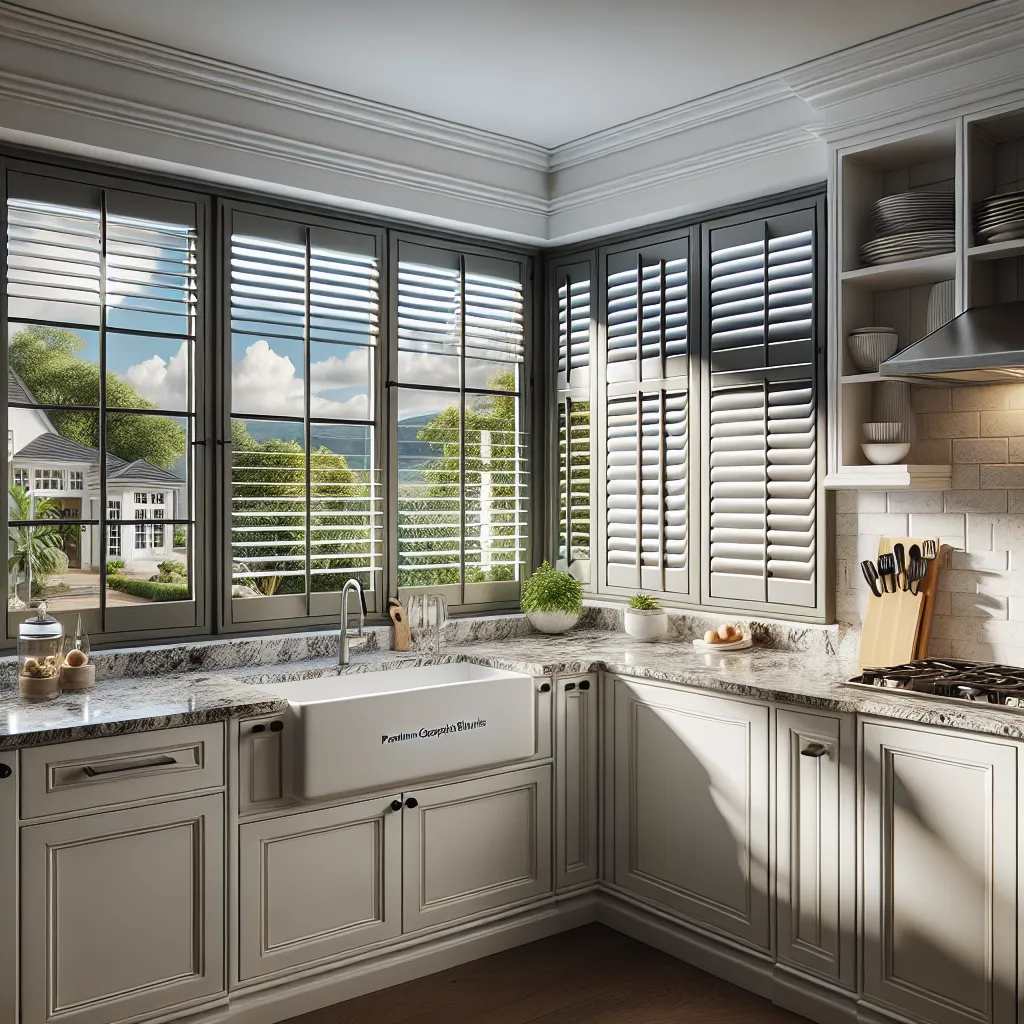
5. Shutters (Composite or Vinyl)
Composite or vinyl plantation shutters are the most durable and moisture-resistant option for basement windows, though they come at a higher price point.
Why shutters work in basements:
- Composite and vinyl materials are completely waterproof
- Louvers provide adjustable light and privacy
- Permanent installation adds value to finished basements
- Clean, architectural appearance elevates the space
- No fabric to absorb moisture or develop odors
- Extremely long-lasting (15-25 year lifespan)
Considerations: Shutters require precise measurement and professional installation. They are the most expensive option on this list but also the most durable and longest-lasting.
Egress Window Compliance
If your basement has or requires an egress window, your window treatment must not impede emergency escape. Egress windows are required by building code in any basement room used as a bedroom.
Egress Window Requirements (IRC Code)
- Minimum opening area: 5.7 square feet
- Minimum opening height: 24 inches
- Minimum opening width: 20 inches
- Maximum sill height: 44 inches from floor
- Window must be operable from inside without tools or special knowledge
Window Treatments That Comply with Egress
Safe choices:
- Inside-mount blinds or shades that do not obstruct the opening mechanism
- Spring-loaded roller shades that retract fully above the opening
- Cordless cellular shades that stack compactly at the top
- Shutters with louvers that do not block the opening path
Potential problems:
- Outside-mount treatments with frames that could block the window from opening fully
- Heavy curtains that could entangle someone during emergency egress
- Any treatment that requires tools or complex manipulation to clear the window opening
Our recommendation: Always install egress window treatments as inside mounts with compact stacking. Test that the window opens fully and quickly with the treatment installed. If there is any doubt, consult your local building inspector.
Small Window Solutions
Basement windows often fall below the minimum sizes offered by standard window treatment manufacturers. Here is how to handle small and non-standard openings.
Minimum Sizes by Product Type
| Window Treatment | Minimum Width | Minimum Height | Custom Available |
|---|---|---|---|
| Faux wood blinds | 12" | 12" | Yes, down to 8" |
| Aluminum mini blinds | 10" | 12" | Yes, down to 6" |
| Roller shades | 12" | 12" | Yes, down to 10" |
| Cellular shades | 9" | 6" | Yes |
| Vinyl shutters | 8" | 12" | Yes |
Tips for Very Small Windows
- Measure carefully: Small measurement errors have a bigger impact on small windows. Measure three times.
- Inside mount when possible: Inside mount preserves the maximum glass area for light entry.
- Choose narrow slats: 1-inch slats in mini blinds provide better proportions on small windows than 2-inch slats.
- Consider a single solution: If you have multiple small basement windows, using the same treatment throughout creates visual consistency.
- Custom sizing is worth it: Paying extra for a perfect fit on a small window looks dramatically better than a standard size that does not quite work.
Hopper Window Treatments
Hopper windows are the most common basement window type. They are hinged at the bottom and tilt inward from the top, which creates a specific challenge for window treatments.
The Hopper Challenge
When a hopper window opens, the top of the window swings into the room. Any window treatment mounted inside the frame must either:
- Be positioned above the swing path of the window
- Be removable or retractable enough to clear the window when it opens
- Be mounted outside the frame entirely
Best Options for Hopper Windows
Inside-mount mini blinds (raised position): Keep the blinds raised when the window is open. The blind headrail sits above the window's swing path.
Outside-mount roller shade: Mounted above the window frame, the roller shade can be raised completely out of the way when the hopper window needs to open.
Magnetic blinds: Some manufacturers offer magnetic-mount blinds that attach directly to the window frame and swing with the window. When the hopper opens, the blind stays attached and moves with it.
Café curtains: A tension rod mounted in the lower half of the window frame with a short curtain provides privacy without interfering with the hopper mechanism.
Window film: For windows that rarely open, privacy window film applied directly to the glass provides permanent privacy with zero interference.
Privacy Solutions for Ground-Level Windows
Ground-level basement windows require more aggressive privacy treatment than elevated windows. Here are strategies ranked from most to least private.
Top-Down/Bottom-Up Shades
Top-down/bottom-up (TDBU) shades are ideal for basement windows. Lower the shade from the top for privacy while leaving the bottom open for maximum light entry. Since most of the view into a basement window comes from above (people looking down), covering the top portion blocks the most critical sightline.
How to position TDBU shades in basements:
- Lower the top to cover roughly 60% of the window (blocks the downward viewing angle)
- Leave the bottom 40% open for light entry
- Adjust based on the specific viewing angle from outside
Frosted or Privacy Window Film
For basement windows where you want permanent privacy without any window treatment hardware, privacy window film is an excellent solution.
Types of privacy film:
- Frosted film: Diffuses light and obscures the view completely
- One-way mirror film: Allows outward views while blocking inward views (works best when exterior is brighter than interior)
- Decorative film: Patterns that obscure visibility while adding visual interest
- Etched glass film: Mimics the look of expensive etched glass
Advantages: No maintenance, no moving parts, no humidity concerns, and maximizes light entry while providing full privacy. Can be combined with a shade for additional light control.
Light-Filtering Shades
Light-filtering cellular or roller shades allow diffused light to enter while obscuring the view from outside. They provide a good balance between privacy and brightness in naturally dark basements.
Light-Maximizing Tips for Basement Windows
Since natural light is precious in basements, your window treatment strategy should preserve as much light as possible.
Strategies to Maximize Light
Choose light-filtering over blackout: Unless your basement is a bedroom or theater, opt for shades that diffuse light rather than blocking it.
Use inside mounts: Inside-mounted treatments cover only the glass area, leaving the full window frame exposed and maximizing the perceived window size.
Select light colors: White or light-colored blinds and shades reflect light deeper into the room rather than absorbing it.
Stack compactly: Choose treatments that fold or roll into a compact stack at the top, leaving the maximum glass area exposed when open.
Clean window wells: If your basement windows have exterior window wells, keep them clean and consider painting them white to reflect more light into the basement.
Add reflective surfaces: Position mirrors or light-colored furniture near basement windows to bounce natural light further into the space.
Consider window well covers: Clear polycarbonate window well covers keep debris out, let light in, and reduce moisture problems.
Top 5 Picks for Basement Windows
1. Cordless Faux Wood Blinds (Best Overall)
The perfect balance of moisture resistance, privacy, light control, and aesthetics. Cordless operation keeps things clean and safe, and the faux wood look elevates a finished basement.
Why they win: Moisture-proof, adjustable privacy, available in small sizes, reasonably priced.
Ideal for: Finished basements, basement bedrooms, home offices.
Price range: $30-100 per window (depending on size)
2. Cordless Aluminum Mini Blinds (Best Budget)
Maximum durability and moisture resistance at the lowest cost. Ideal for outfitting multiple basement windows without a significant investment.
Why they win: Cheapest moisture-proof option, available in very small sizes, extremely durable.
Ideal for: Utility basements, laundry rooms, workshops, unfinished basements.
Price range: $15-50 per window
3. Top-Down/Bottom-Up Cellular Shades (Best for Privacy + Light)
The top-down/bottom-up feature is perfectly suited to basement windows where you need to block the downward viewing angle while letting light in from below.
Why they win: Solves the basement-specific privacy angle problem while maximizing natural light.
Ideal for: Finished basements at street level, basement living rooms.
Price range: $60-180 per window
4. Vinyl Roller Shades (Best for Basement Bedrooms)
Room-darkening vinyl roller shades provide the blackout capability needed for sleeping while resisting basement humidity.
Why they win: Moisture-resistant blackout capability in a compact, clean-looking package.
Ideal for: Basement bedrooms, guest rooms, media rooms.
Price range: $25-80 per window
5. Composite Plantation Shutters (Best Premium)
For homeowners who want to make a basement feel like a true living space, composite shutters add an architectural element that no other window treatment can match.
Why they win: Completely waterproof, architectural aesthetic, extremely long lifespan.
Ideal for: High-end finished basements, basement apartments, in-law suites.
Price range: $150-400 per window
Installation Tips for Basement Windows
Dealing with Concrete and Masonry
Many basement windows are set in concrete or masonry walls, which complicates mounting.
For concrete walls:
- Use a hammer drill with masonry bits
- Tapcon screws provide secure mounting in concrete
- Pre-drill holes slightly smaller than the screw diameter
- Blow out drilling dust before inserting screws
- Consider adhesive or tension-mount options if you want to avoid drilling
For window frames in concrete:
- If the window has a wood or vinyl frame, mount directly to the frame
- Inside mounts are easier than outside mounts on concrete
- For outside mounts on concrete, use concrete anchors rated for the shade weight
Moisture Precautions During Installation
- Check for active moisture on the window frame before installing
- Address any water infiltration issues before mounting window treatments
- Leave a small gap at the bottom of inside-mount treatments for air circulation
- Do not seal all edges of a shade in a high-humidity basement (traps moisture against the glass)
Maintenance Schedule for Basement Window Treatments
Basement window treatments need more frequent maintenance than those in above-grade rooms due to humidity and dust.
Monthly
- Wipe faux wood or aluminum blinds with a dry or slightly damp cloth
- Check for signs of mildew on any fabric components
- Ensure window wells are draining properly (standing water increases humidity)
Quarterly
- Deep clean all window treatments with appropriate cleaners
- Check for condensation damage on or behind shades
- Inspect cordless mechanisms for smooth operation
- Verify that dehumidifier is maintaining target humidity levels
Annually
- Assess all treatments for wear, mildew, or moisture damage
- Replace any fabric-based treatments showing mildew that cannot be fully cleaned
- Check and tighten all mounting hardware
- Reseal any gaps around window frames that could admit moisture
Final Thoughts
Basement windows demand a different approach than the rest of your home. Moisture resistance is the non-negotiable baseline, and from there, your choice depends on how you use the space. For most homeowners, cordless faux wood blinds hit the sweet spot of durability, aesthetics, and affordability. If privacy at ground level is your primary concern, top-down/bottom-up shades solve the unique sightline problem that basement windows face.
Whatever you choose, avoid real wood, untreated fabric, and any material that cannot handle sustained humidity above 50%. Your basement windows may be small, but treating them correctly makes the entire space more comfortable, private, and inviting.
Ready to upgrade your basement windows? Browse our moisture-resistant collections or contact our experts for help with custom sizing and unusual window shapes. Preview fabrics online to compare materials and colors before you buy.