
Best Blinds for Noise Reduction: Create a Quieter Home
Best Blinds for Noise Reduction: Create a Quieter Home
Street traffic, barking dogs, construction, and noisy neighbors can make your home feel less like a sanctuary and more like a front-row seat to the world outside. While window treatments cannot replace professional soundproofing, the right blinds and shades can make a meaningful difference in reducing unwanted noise, especially when combined with smart layering strategies.
This guide covers the science behind noise-reducing window treatments, compares the most effective options, and provides actionable tips for creating a quieter home in every room.
How Window Treatments Reduce Noise
Understanding how sound interacts with windows helps you make better choices about noise-reducing blinds.
The Science of Sound and Windows
Windows are typically the weakest point in a wall's sound barrier. A standard single-pane window has a Sound Transmission Class (STC) rating of around 26, while a well-insulated wall rates 45-50. Even dual-pane windows typically rate only 28-32. That gap means most exterior noise enters your home through the glass.
Window treatments reduce noise through three mechanisms:
- Absorption — Soft, porous materials absorb sound waves rather than reflecting them. The thicker and more textured the material, the more sound energy it converts to heat.
- Damping — Heavy materials slow sound wave vibration, reducing the amplitude (volume) of noise that passes through.
- Air gap creation — The space between a window treatment and the glass creates a buffer zone that disrupts sound transmission.
What STC Ratings Mean
Sound Transmission Class (STC) is the standard measurement for how well a building element blocks sound. Here is what the numbers mean in practical terms:
| STC Rating | What You Experience |
|---|---|
| 25 | Normal speech clearly heard through barrier |
| 30 | Loud speech heard and understood |
| 35 | Loud speech heard but not understood |
| 40 | Loud speech heard as a murmur |
| 45 | Most sounds effectively blocked |
| 50+ | Very loud sounds barely heard |
A well-chosen window treatment can improve your window's STC rating by 3 to 8 points, which translates to a noticeable reduction in perceived noise, sometimes up to 60% when measured in decibels.
Best Window Treatments for Noise Reduction
1. Honeycomb (Cellular) Shades — The Top Performer
Honeycomb cellular shades are the single most effective window treatment for noise reduction. Their unique structure creates air pockets that trap and absorb sound waves before they enter your room.
Noise reduction performance:
- Single-cell shades: Reduce noise by 30-40%
- Double-cell shades: Reduce noise by 40-50%
- Triple-cell shades: Reduce noise by 50-60%
- Blackout cellular with side tracks: Maximum noise reduction
Why cellular shades excel at noise reduction:
- Honeycomb cells act as sound-absorbing chambers
- Air trapped in cells provides natural insulation against sound transmission
- Soft pleated fabric absorbs high-frequency sounds (voices, music, TV)
- When combined with side tracks, they create a sealed air gap over the window
- Available in single, double, and triple cell configurations for varying levels of sound absorption
The air gap advantage: Mounting cellular shades with a 2-4 inch gap between the shade and the glass creates an additional sound buffer. This air gap is one of the most important factors in noise reduction. Use extension brackets during installation to maximize this gap.
Browse our cellular shade collection
2. Roman Shades with Blackout Lining
Lined roman shades combine heavy fabric mass with multiple fabric layers, both important factors for sound damping.
Noise reduction performance:
- Unlined roman shades: 15-25% noise reduction
- Blackout-lined roman shades: 30-45% noise reduction
- Thermal-lined roman shades: 35-45% noise reduction
What makes them effective:
- Multiple fabric layers increase mass and damping
- Blackout lining adds a dense barrier layer
- Fabric folds create additional surface area for sound absorption
- Heavy fabrics like velvet or chenille perform best
- Full coverage from frame to frame minimizes sound leakage
Best for: Bedrooms and living rooms where you want both noise reduction and a decorative, soft aesthetic.
3. Roller Shades with Acoustic Backing
Standard roller shades offer minimal noise reduction, but specialized acoustic roller shades with dense backing materials can perform surprisingly well.
Noise reduction performance:
- Standard roller shade: 10-15% noise reduction
- Acoustic-backed roller shade: 25-40% noise reduction
- Dual roller (sheer + blackout): 30-45% noise reduction
Key features to look for:
- Dense, multi-layer fabric construction
- Acoustic foam or mass-loaded vinyl (MLV) backing
- Side channels that seal the shade against the window frame
- Bottom bar with brush seals to close the gap at the sill
4. Vertical Cellular Shades
For sliding glass doors and wide windows, vertical cellular shades apply the same honeycomb sound-absorption principle in a vertical orientation.
Noise reduction performance: 30-50% depending on cell count and fabric density.
Best for: Sliding glass doors facing busy streets, patios adjacent to noisy neighbors, or large window walls.
5. Layered Window Treatments
The most effective noise reduction strategy is layering multiple window treatments. Each layer adds mass, absorption, and air gaps.
Effective layering combinations:
- Cellular shade + heavy curtains: The cellular shade provides absorption while curtains add mass. This combination can achieve 50-65% noise reduction.
- Roller shade + roman shade: A dense roller shade close to the glass plus a lined roman shade creates two barriers with an air gap between them.
- Sheer + blackout + curtains: Three layers provide maximum sound barriers with multiple air gaps.
Noise Reduction Comparison Table
| Window Treatment | Noise Reduction | STC Improvement | Cost per Window | Best For |
|---|---|---|---|---|
| Triple-cell cellular shade | 50-60% | +6-8 | $150-350 | Maximum reduction |
| Double-cell cellular shade | 40-50% | +5-7 | $120-280 | Best value |
| Blackout roman shade | 30-45% | +4-6 | $130-300 | Style + function |
| Acoustic roller shade | 25-40% | +3-5 | $100-250 | Modern look |
| Single-cell cellular shade | 30-40% | +3-5 | $80-200 | Budget option |
| Heavy curtains (lined) | 25-35% | +2-4 | $80-200 | Layering partner |
| Standard roller shade | 10-15% | +1-2 | $40-120 | Minimal effect |
| Aluminum mini blinds | 5-10% | +0-1 | $20-60 | No meaningful reduction |
| Sheer curtains | 3-5% | +0-1 | $30-80 | No meaningful reduction |
Room-by-Room Noise Reduction Guide
Street-Facing Windows
Street-facing windows are the primary source of traffic noise in most homes. Effective treatment for these windows can transform your living space.
Recommended approach:
- Install double-cell cellular shades with blackout fabric
- Use extension brackets to create a 3-4 inch air gap from the glass
- Add side tracks or channels to seal edges
- Layer with heavy, floor-length curtains for maximum effect
- Ensure the bottom bar sits flush with the sill to prevent sound leakage
Expected results: A well-executed layered approach on street-facing windows can reduce traffic noise perception by 50-65%, turning a distracting roar into background hum.
Apartment Living
Apartment dwellers face unique noise challenges. Thin walls, shared spaces, and inability to modify windows make window treatments one of the few noise-reduction tools available.
Apartment-friendly strategies:
- Choose inside-mount cellular shades (no drilling into window frames required for many models)
- Tension-mounted cellular shades require zero hardware
- Magnetic window inserts with acoustic properties can supplement blinds
- Layering is especially effective in apartments where structural changes are not permitted
Pro tip for renters: Many landlords will allow tension-mounted or adhesive-mounted window treatments that leave no marks or holes. Double-cell cellular shades in a tension mount can significantly reduce street noise without violating your lease.
Home Offices
With remote work now standard for many professionals, noise-reducing window treatments in home offices have become a legitimate productivity investment.
Home office recommendations:
- Double-cell cellular shades in light-filtering fabric (maintain natural light while reducing noise)
- Add a secondary blackout roller shade for video calls where glare and noise both matter
- Consider motorized operation for quick adjustment during the workday
- Side channels are especially important in offices to prevent sound leakage during calls
Measured impact: Home workers report that cellular shades reduce distracting background noise enough to eliminate the need for noise-canceling headphones in moderate-noise environments.
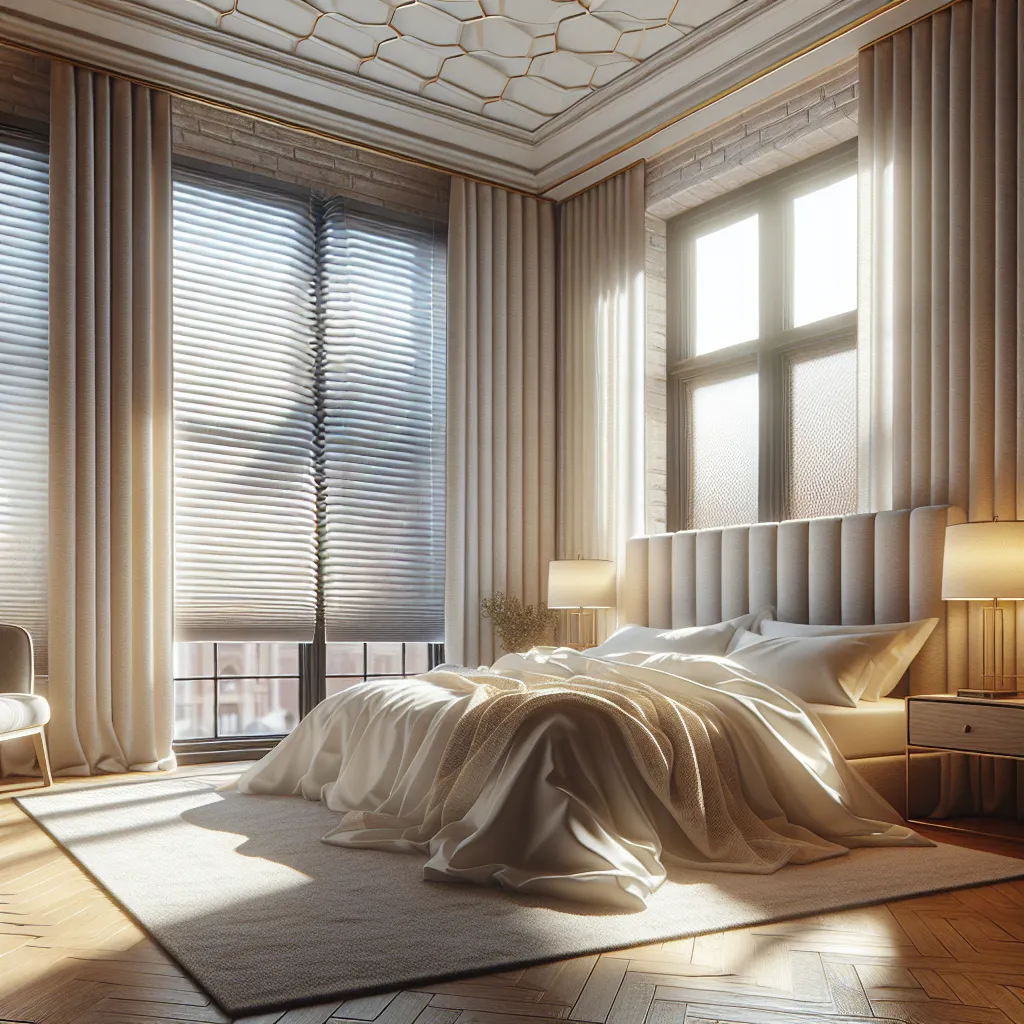
Bedrooms
Sleep quality depends heavily on ambient noise levels. Even moderate noise can prevent deep sleep cycles without fully waking you.
Bedroom noise reduction strategy:
- Blackout double-cell or triple-cell cellular shades (darkness + noise reduction)
- Side channels to seal light and sound gaps
- Heavy blackout curtains layered over the cellular shades
- Consider all windows in the bedroom, not just the noisiest one
Expected results: A properly treated bedroom can reduce exterior noise by 55-65% using layered cellular shades and curtains, often enough to bring noise below the 30-decibel threshold recommended for quality sleep.
Advanced Noise Reduction Strategies
Sealing the Gaps
The biggest weakness in any window treatment's noise reduction is the gaps around its edges. Sound, like water, finds the path of least resistance.
How to seal gaps effectively:
- Side channels or tracks — Aluminum or plastic channels that the shade slides within, sealing the left and right edges. This alone can improve noise reduction by 15-20%.
- Top valance or cassette — A closed headrail that prevents sound from entering over the top of the shade.
- Bottom seal — A weighted bottom bar with brush or rubber seals that closes the gap at the window sill.
- Overlap sizing — Order outside-mount shades 3-4 inches wider and longer than the window opening to cover frame gaps.
The Double-Shade Technique
Install two separate shades on the same window for maximum noise reduction:
- Inner shade (close to glass): Dense blackout roller shade mounted inside the window frame
- Outer shade (room side): Double-cell cellular shade mounted on the frame face with extension brackets
This creates three sound barriers (roller shade, air gap, cellular shade) and can rival the performance of acoustic window inserts at a fraction of the cost.
Complementary Soundproofing
Window treatments work best as part of a broader noise-reduction strategy:
- Weatherstripping — Seal gaps around window frames (often the biggest noise leak)
- Window film — Acoustic window film adds mass to the glass itself
- Window inserts — Clear acrylic panels that mount inside the frame, creating a large sealed air gap
- Rugs and soft furnishings — Reduce noise reflection inside the room
- Bookcases on shared walls — Add mass to thin apartment walls
What to Expect: Setting Realistic Goals
It is important to set realistic expectations about what window treatments can and cannot do for noise reduction.
Window treatments CAN:
- Reduce perceived noise by 30-60% depending on type and installation
- Improve STC ratings by 3-8 points
- Make traffic noise, voices, and general urban sounds noticeably quieter
- Help you sleep better by reducing nighttime noise intrusion
- Improve focus in home office environments
Window treatments CANNOT:
- Eliminate bass-heavy noise (heavy trucks, construction equipment, bass music)
- Replace professional soundproofing for extreme noise environments
- Block noise that enters through walls, floors, or ceilings
- Achieve STC improvements beyond about 8-10 points
- Match the performance of acoustic window inserts or secondary glazing
If your noise problem is severe (living next to a highway, train tracks, or airport), window treatments should be one layer of a multi-faceted approach that includes acoustic window inserts, weatherstripping, and potentially secondary glazing.
Cost vs. Impact Analysis
Noise-reducing window treatments offer excellent value compared to structural soundproofing alternatives.
| Solution | Cost per Window | Noise Reduction | Installation |
|---|---|---|---|
| Double-cell cellular shade | $120-280 | 40-50% | DIY friendly |
| Cellular + curtain layer | $200-450 | 50-65% | DIY friendly |
| Acoustic roller shade | $100-250 | 25-40% | DIY friendly |
| Acoustic window insert | $300-700 | 60-75% | Professional |
| Secondary glazing | $500-1,200 | 70-80% | Professional |
| Window replacement (triple pane) | $800-2,000 | 75-85% | Professional |
For most homeowners, double-cell cellular shades with curtains provide the best noise-reduction value without requiring professional installation or structural changes.
Final Thoughts
Noise-reducing blinds will not turn your home into a recording studio, but they can meaningfully improve your quality of life, especially if you live on a busy street, in an apartment, or work from home. Honeycomb cellular shades remain the standout performer, and when combined with heavy curtains and proper edge sealing, they can reduce unwanted noise by more than half.
Start with your most noise-affected room, typically the bedroom or home office, and invest in quality double-cell cellular shades with side channels. You will notice the difference immediately and can then expand to other rooms based on your experience.
Ready to make your home quieter? Explore our cellular shade collection or talk to our window treatment experts about the best noise reduction strategy for your space. Order high-detail fabric previews to compare materials before you commit.